The USD pipeline 3D production 2026 landscape is experiencing unprecedented momentum as Universal Scene Description (USD) transforms from a Pixar proprietary format into the backbone of modern 3D workflows. Major studios, software developers, and asset creators are rapidly adopting USD as the universal interchange format, fundamentally changing how teams collaborate on complex productions. This shift represents more than just another file format—it’s establishing a new paradigm for asset management, pipeline efficiency, and cross-platform compatibility that’s reshaping the entire industry.
As 2026 unfolds, the implications for 3D artists, VFX professionals, and production teams are becoming increasingly clear. USD’s non-destructive workflow capabilities, combined with its robust referencing system and layered composition model, are solving longstanding collaboration challenges that have plagued studios for decades. Understanding and implementing USD pipelines is no longer optional for professionals seeking to remain competitive in today’s interconnected production environment.

Understanding USD: Why It’s Becoming Industry Standard
Universal Scene Description has evolved far beyond its origins at Pixar Animation Studios to become the de facto standard for 3D scene interchange and collaboration. The format’s strength lies in its composition arcs system, which allows artists to layer, reference, and override scene data without destructive edits to the original assets. This capability proves invaluable when multiple departments need to work simultaneously on shared assets—lighting artists can adjust illumination while animation teams continue character work, all within the same USD stage.
The technical architecture supporting USD’s adoption includes sophisticated variant sets that enable artists to switch between different versions of the same asset seamlessly. For instance, a character model can have multiple levels of detail (LODs) stored within a single USD file, with the appropriate version automatically selected based on viewing distance or rendering requirements. This approach significantly reduces file duplication and simplifies asset management across large productions.
USD’s prim specifications and schema system provide standardized ways to describe complex 3D data, ensuring consistency across different software packages. The format supports everything from basic geometry and materials to advanced features like subdivision surfaces, instancing, and complex shading networks. This comprehensive coverage eliminates the data loss and conversion artifacts that traditionally plague multi-software pipelines, making USD an attractive solution for productions requiring seamless tool interoperability.
Major Software Adding USD Support in 2026
The software landscape in 2026 reflects unprecedented USD integration across major 3D applications. Autodesk Maya has expanded its USD capabilities significantly, now supporting real-time USD stage editing directly within the Maya viewport. Artists can import, reference, and modify USD assemblies while maintaining live connections to the original files, enabling true collaborative workflows where changes propagate automatically across team members’ workstations.
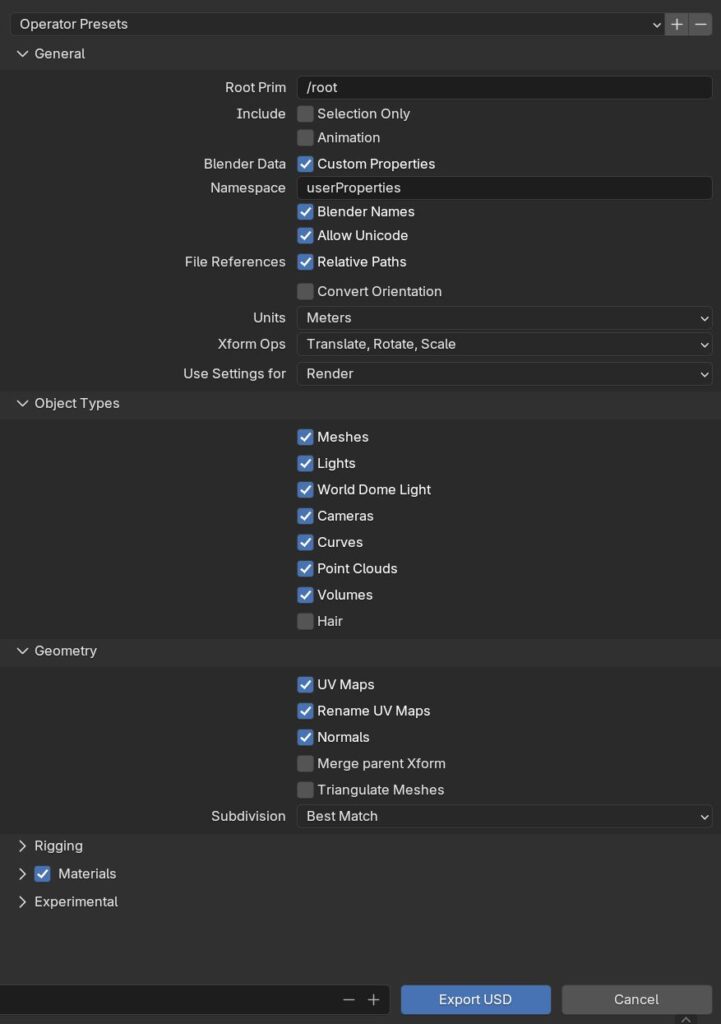
Blender 4.1’s USD implementation has matured considerably, offering native USD export and import with full material translation support. The integration preserves Blender’s node-based shading systems when exporting to USD, maintaining compatibility with other USD-aware applications. Cinema 4D has introduced USD Scene Nodes, allowing procedural assembly of USD stages through C4D’s established node-based workflow, making complex scene composition more accessible to motion graphics artists.
Real-time engines are driving much of the USD adoption momentum. Unreal Engine 5.4 now features USD Stage actors that can dynamically load and unload massive USD assemblies based on streaming requirements, crucial for virtual production workflows. Unity’s USD package has evolved to support USD variants and animation clips natively, enabling game developers to leverage USD assets directly from film and television productions. This cross-pollination between industries is accelerating USD standardization across the entire 3D ecosystem.
Rendering Engine Integration
Rendering engines have simultaneously embraced USD as their primary scene description format. Arnold 7.3 now reads USD scenes natively, bypassing traditional scene translation bottlenecks that previously slowed render times. V-Ray 6.2’s USD Hydra delegate allows real-time preview of USD scenes with production-quality materials and lighting, significantly accelerating the look development process. These improvements directly impact production efficiency by reducing the technical overhead associated with complex scene management.
Setting Up USD Workflows for Animation and VFX
Implementing effective USD workflows requires careful consideration of asset organization, layer structure, and collaboration protocols. The foundation of any USD pipeline starts with establishing clear asset hierarchies and namespace conventions. Studios typically organize USD stages using a three-tier structure: shot-level assemblies that reference department-level sublayers, which in turn reference individual asset USD files. This approach enables selective loading and modification while maintaining referential integrity across the entire production.
Asset preparation for USD workflows involves optimizing geometry topology and UV layouts to ensure consistent behavior across different software packages. Models should maintain clean quad topology where possible, with proper edge flow for subdivision surfaces. UV coordinates must be normalized and properly oriented, as USD’s material binding system relies on consistent UV naming conventions. Texture resolution should align with production requirements—typically 2K for background assets, 4K for hero elements, and 8K for extreme close-ups requiring maximum detail fidelity.
The layer stack approach fundamental to USD enables non-destructive overrides at every production stage. Animation layers contain transform data and deformation caches, while lighting layers hold illumination setups and material overrides. Effects layers incorporate simulation data and procedural elements. This separation allows departments to work independently while maintaining a unified scene structure, dramatically reducing pipeline bottlenecks common in traditional workflows.
Version Control and Asset Management
USD’s referencing system integrates naturally with version control workflows, but requires specific protocols to maintain stability. Studios implement asset versioning schemas that automatically update references to approved asset versions while preserving the ability to revert to previous iterations when necessary. The key lies in maintaining published asset registries that track dependency relationships, ensuring that updates to upstream assets don’t inadvertently break downstream work.
USD Asset Management and Collaboration Benefits
The collaborative advantages of USD extend far beyond simple file interchange. The format’s opinion strength system allows different departments to contribute specialized data while maintaining clear hierarchies for conflicting edits. When modeling, rigging, and surfacing teams all need to modify the same asset, USD’s composition system ensures that each department’s contributions are preserved and properly prioritized according to predefined rules.
Asset dependency tracking becomes significantly more robust with USD’s built-in reference system. Studios can visualize the complete dependency graph for any shot or sequence, identifying potential bottlenecks before they impact production schedules. This visibility proves crucial for resource planning and deadline management, particularly on large-scale productions where hundreds of artists contribute to shared asset libraries.
The format’s payload mechanism enables selective loading of heavy geometry and texture data, allowing artists to work with proxy representations until full detail becomes necessary. A character artist can work with a lightweight proxy mesh during blocking and animation phases, then load the full-resolution geometry only for final rendering. This approach maintains interactive performance while preserving access to complete asset fidelity when required.
Production Scale Benefits
At enterprise scale, USD’s benefits compound significantly. Studios report 40-60% reductions in scene assembly time when using USD workflows compared to traditional approaches. The ability to update asset references globally across hundreds of shots simultaneously eliminates much of the manual labor associated with large-scale asset revisions. These efficiency gains translate directly into cost savings and shorter production timelines, making USD adoption an economic necessity for competitive studios.
Future of USD in Real-Time and Virtual Production
The convergence of USD with real-time rendering and virtual production workflows represents perhaps the most exciting development in the format’s evolution. LED volume stages now rely heavily on USD’s streaming capabilities to manage massive environment assets that must load and unload dynamically based on camera movement and performance requirements. The format’s inherent support for level-of-detail switching enables real-time engines to maintain consistent frame rates while preserving visual fidelity where it matters most.
Machine learning integration with USD workflows is beginning to show significant promise. AI-powered tools are emerging that can analyze USD scene graphs to automatically optimize asset placement, suggest LOD transitions, and even predict rendering bottlenecks before they occur. These intelligent systems leverage USD’s structured metadata to make informed decisions about scene optimization, further reducing the technical overhead associated with complex productions.
The gaming industry’s adoption of USD is accelerating as developers recognize the format’s potential for procedural content generation and dynamic asset streaming. Open-world games benefit from USD’s ability to compose vast environments from reusable components while maintaining efficient memory usage. This trend suggests a future where the boundaries between film, television, and interactive entertainment continue to blur, unified by shared USD-based asset pipelines.
Emerging Technologies and USD
Virtual and augmented reality applications are beginning to leverage USD for complex scene management, particularly in enterprise and educational contexts. The format’s support for temporal data and animation makes it well-suited for interactive experiences that require sophisticated asset management. As these technologies mature, USD’s role as a universal interchange format becomes even more critical for content creators targeting multiple platforms and devices.
Conclusion
The USD pipeline transformation occurring throughout 2026 represents a fundamental shift in how 3D content is created, managed, and delivered across industries. As software tools continue expanding their USD capabilities and studios refine their implementation strategies, the format’s role as the universal standard for 3D scene description becomes increasingly solidified. Artists and studios that embrace USD workflows now position themselves advantageously for the collaborative, multi-platform production environment that defines modern content creation.